Thursday, August 30, 2012

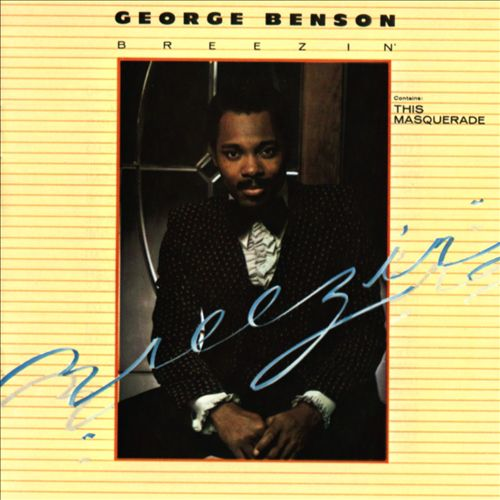
George Benson - Breezin' (1976)


Famous for the tune "This Masquerade," Benson's 1976 release Breezin' catapulted Benson into the pop spotlight. Despite this album being released it's hard to not notice a connection to Benson's long-time label CTI Records. Keeping in mind Creed Taylor's seeming philosophy of mixing the artistic with the commercial seems to really apply to this album to a degree. In many ways Breezin' is a softer side to his work with CTI and Benson definitely "crossed over" more to achieve his pop success. The title track was written by Bobby Womack and the arrangement of Breezin' closely resembles an earlier version by Gábor Szabó, who disdained Benson's commercial success with his work. However, "This Masquerade" is the real commercial success of the album featuring vocals by Benson and his impressive ability to sing in unison with his guitar while soloing. An arrangement of José Feliciano's "Affirmation" is a personal favorite of mine because compared to the rest of the album it is a more intimate track without the massive instrumentation on the majority of the album. This track also meshes well with Benson's cool, lyrical approach to guitar and probably is the best example of the extremes of his technique. Breezin' really is an album of its time with orchestral accompaniment, electric piano, and a cool, laidback feel that is so intimately tied with the mid-1970s in music. However, the album is some of Benson's finest commercial work without compromising his identity as a jazz guitarist. Breezin' was the harbinger of Benson's real pop success to come like  "On Broadway" and "Give Me the Night."

Wednesday, August 22, 2012

Todd Rundgren - Runt: The Ballad of Todd Rundgren (1971)


I've been looking to upload this album for awhile, but I like the variety my blog has so I try to space out posts that have the same artists. The Ballad of Todd Rundgren builds off what was established in Runt. The "Runt" persona built around a quirky and dark humor turns to a slower side with an album primarily composed of ballads. As far as early Todd Rundgren albums go, this is the most dominated by Rundgren's piano playing. Even Something/Anything? doesn't have the myriad  of ballads or relaxed tunes like this album does. "Long Flowing Robe" starts out at the album and is ironically the one really uptempo, upbeat track on the album. From its opening seconds with the electric harpsichord and the ironic lyrics "Long Flowing Robe" has a witty sense of humor about a lustful man and excellent use of overdubbed vocal harmony by Rundgren. After the opening track, the album goes to a depressing side as the album artwork would suggest. "Wailing Wall" is the next standout track whose lyrics suggest an elaborate personification of his own depression which reveals itself throughout the progression of the track. The lyrics match well with the sparse treble piano chords accompanied by a low bass line and Rundgren's soft falsetto that show real emotion. "The Range War" is noteworthy because of the typical Rundgren quirky humor which is evident throughout his career. "Chain Letter" starts out with Rundgren's falsetto voice accompanied by guitar and builds to an rhythmically upbeat section. That being said, the intro recalls an old love and the following section comments on the disillusioned voice of the intro. The next highlight and my favorite track of the album is "Be Nice to Me." The handbells really add a great layering effect to a track full of Rundgren's treble piano full of treble chords and a driving bass line." As usual, this track owes a lot to Rundgren's soft falsetto and the numerous instances of vocal harmony being overdubbed. If you liked my post of Runt or like the hits like "Hello It's Me" or "I Saw the Light," The Ballad of Todd Rundgren is definitely worth a listen.

Thursday, August 16, 2012

Maynard Ferguson - Chameleon (1974)


This album has a lot of personal history for me as it was the first jazz album (even though it's crossover jazz) I ever listened to. Consequently it's also the album I listened to when I realized I wanted to pursue music as a career. I would never say that Maynard's 70s material is his finest work, but it is accessible. This album is really the last before Maynard totally embraced disco and in turn commercialism in the late 70s with Conquistador. The opening title track "Chameleon" is a great take on the Herbie Hancock classic that came out earlier that year on Head Hunters. One of the highlights of the album is the following track "Gospel John," a Jeff Steinberg tune famous for its intro that reminds the listener of a preacher. "Gospel John" is also noteworthy for showcasing Maynard as a multi-instrumentalist as he plays the melody following the intro on baritone. The Randy Purcell arranged "The Way We Were" features his fine lyrical trombone work, but also shows his ability as an arranger incorporating a variety of textures and colors in his backgrounds. "La Fiesta" is a track Maynard borrowed from band alumnus Chick Corea is also one of the highlights of the album. The Rhodes piano and the horn lines sound like jazzed-up mariachis, but through the rhythmic shifts the band changes its feel to a more straight-forward jazz feel. "La Fiesta" is truly a great arrangement for its incorporation of Latin elements while maintaining a big band rhythmic feel. The last two tracks are noteworthy because Ferguson typically incorporated at least one tune into his albums that was from an earlier time or sounds like it should be. The Gershwin/Duke tune "I Can't Get Started" was made famous by Bunny Berigan in 1937 and Maynard like so many other trumpet players feels the need to record the song. Ferguson's version is different in that many of the words are altered. For instance, "Stan Kenton made me a star" shows personal history, but there's just the plain humorous lines like "I was invited to tea by the queen/Linda Lovelace." The final track and final highlight of the album is "Superbone Meets the Bad Man" an uptempo bop tune that gets its name from the instrument Maynard is playing and baritone saxophonist Bruce Johnstone's nickname. The Superbone is a combination slide/valve trombone designed by Maynard and played by himself and Don Ellis in the mid-to-late 1970s. While Maynard definitely sticks more to the valves than the slide, he and Johnstone produce some magnificent solos and a great close to an album.

My Philosophy

I know it's been awhile since I last posted and reviewed an album. One thing you might not consider is that when you start a blog the material you have in your "immediate consciousness" will soon dwindle until the point where you have "digest" new albums. I could review albums as I listen to them, but I don't think the product would be quite as good. I like to have an "intimate relationship" with an album; I will listen to it intently for a few weeks. This way I know more than the songs that stand out. I can actually dissect the musical elements of the piece, rather than talk about the album in poetic terms reinforced by my own emotional aestheticism. The month of August has been so spotty due to my need to listen to more material at a rate that I was posting, which really isn't possible. I do have posts planned month in advance, but there's a reason I'm not posting them now. I try to have a decent mixture, so I won't post two albums by the same artist a week apart from each other. All this being said, you should expect another album by the end of the week and at least two by Thursday next week.

Monday, August 6, 2012

Paul Desmond - Summertime (1969)


Paul Desmond is a name even the casual jazz fan should be familiar with, but that may not be the case. His composition "Take Five" is probably more famous than the man that wrote it to the general public. His tenure with the Brubeck quartet enabled his sound to be familiar, but until he embarked on a solo career his name was always secondary to Brubeck's which is really quite unfortunate. Consequently, Summertime was recorded a little over a year after the Brubeck quartet broke up, officially taking Desmond out of "retirement." Summertime is a bossa nova album that fits Desmond's sound so well whether the tune is a ballad or an uptempo samba. Desmond is really one of the few altoists in the mid-20th century that was able to create a sound independent of Charlie Parker. The opening track "Samba with Some Barbecue" is a personal favorite and is a bossa nova treatment of the Louis Armstrong chart "Struttin' with Some Barbecue." Even though "Autumn Leaves" seems to be played by every jazz artist on the planet, Desmond's version is definitely worth giving a listen. "Autumn Leaves" and much of the album owes a lot to arranger Don Sebesky, who after his stints with figures like Stan Kenton and Maynard Ferguson in the 1950s turned to conducting and arranging in the 1960s. In my opinion, you can hear a lot of influence of Gil Evans in the way Sebesky arranges, but also in the album as a whole. The lush brass augmented by the presence of French horns and the way he writes around the solo voice reminds me of Gil Evans' work with Miles Davis. Through this collaboration tracks like "Autumn Leaves" and "Summertime" seem fresh, original, and practically like they were always supposed to be bossa nova charts.

Wednesday, August 1, 2012

Chase - Ennea (1972)


I was going to wait a bit longer to post this, but as some may have noticed if you visited yesterday my other post was deleted. Chase is a favorite of mine, and while their final album is undoubtedly my favorite, Ennea is much more like Pure Music than their first album. The Greek translation of "nine," Ennea is named for the nine members of Chase and the Greek Suite which would have originally been on one side of the LP. Ennea sees Bill Chase and his band breakaway from the norms of jazz-rock and move into a more original sound incorporating elements of funk and even Middle Eastern music. Addressing the music aside from the suite, "So Many People" is the standout track and was the single when the album was released in 1972. Unfortunately, it did not chart as well as expected, so Chase wasn't in the limelight as much as when his first album took off. "I Can Feel It" and "It Won't Be Long" are also memorable tracks that primarily feature G.G. Shinn, the vocalist of the band at the time, along with solo breaks reminding the listener how much command of the upper register Bill Chase had. "Swanee River" is a real oddity of a track. Apparently, Bill Chase was working on an original composition when G.G. Shinn noted that it had the same chord changes as "Swanee River," so the original tune was scrapped and this was the result. However, the real treasure of the album is definitely the suite. Part of the reason this album didn't sell well is because of the suite, because it isn't that accessible to the untrained listener. The Greek Suite is hands down the least commercial music Chase ever released. Even though there are vocals, it's pretty obvious from the opening cadenza of "Cronus" that the real focus is Bill Chase and the trumpet section. There are a variety of influences across the suite from rock, jazz, and even Middle Eastern music. In many parts of "Zeus" the track sounds more like an uptempo jazz chart than anything rock related. My personal favorite of the suite is "Aphrodite Part II" which is actually in a double harmonic scale (Bayati if you use the Middle Eastern name). Roughly, it is a major scale with lowered second and sixth degrees. Bill Chase was a critically well received arranger even before Chase when he was lead trumpet for Woody Herman, and it is the Greek suite which really exemplified this reputation. Unfortunately, it is probably one of the most skimmed-over part of his discography. I own the entire Chase discography on vinyl, and this album in particular makes me lament the end of the LP. It's not that I hate new formats, but the liner artwork in the album is particularly intriguing and it is the little things like that that you lose in the plastic cases they use today.

Friday, July 20, 2012

Stan Getz & João Gilberto - Getz/Gilberto (1963)


Even if it wasn't the album that started the bossa nova craze, Getz/Gilberto was definitely one of its crowning achievements. As far as bossa nova is concerned, this was the album that brought Brazil and America together. While Jazz Samba was primarily American musicians playing Brazilian music, Getz/Gilberto was the album that brought both worlds together. It brought Brazil's greatest performer of bossa in João Gilberto and its greatest composer in Antônio Carlos Jobim. While the majority of the album is penned by Jobim and contains such well-known classics as "The Girl from Ipanema" and "Desafinado," the roots of bossa nova are celebrated as well in the track "Para Machucar Meu Coração," penned by Ary Barroso who most famously wrote "Brazil." The same could be said for the track "Doralice" penned by Laurindo Almeida, a Brazilian guitarist whose career began in the late 1940s with Stan Kenton. When many people talk about bossa nova, they often don't realize that it comes from this great Brazilian tradition that goes back to samba at Carnaval to classical composers like Villa-Lobos. While this album celebrates the roots of bossa nova, it also premieres some of its finest material. "Desafinado" is a personal favorite that which translates as "off-key" and speaks of a young man who can't please the ears of a woman he loves because his voice is often off key. "Desafinado" is one of Jobim's most well-known songs, but hands-down "The Girl from Ipanema" is the most well-known song of Jobim or bossa nova. "Vivo Sonhando" is a personal favorite for the way that it hops around chords while the melody repeats an F# and resolves to a D. If you analyze "Vivo Sonhando" or other bossa nova charts, you will realize that the harmony is very forward thinking. Gmaj7 to Ebmaj7 is a strange resolution when the song is in G. However, when you realize bossa nova is really chromatic and you factor in chromaticism to your chordal analysis it doesn't seem so strange. It's hard to say if this album is the best album of all the people involved, but it surely is at the highpoint of their careers and commercial success.

Wednesday, July 18, 2012

Todd Rundgren - Runt (1970)


Known primarily for the hits off of his 1972 album Something/Anything? including "Hello It's Me" and "I Saw the Light," Todd Rundgren was heavily influenced early on by Laura Nyro. When Rundgren was in his original group the Nazz he was even approached by Nyro to head her band. What's most interesting is how Rundgren adopts Nyro's eclecticism and applies it to his roots in the rock idiom. In case you are doubtful about the connection, the track "Baby Let's Swing" refers to Laura Nyro by name. On Runt, Rundgren is deep into the "Runt persona" which one could interpret as both his departure from the Nazz in spirit as well as his first foray into writing a whole album. As far as the content is concerned, the album's subject matter is practically the antithesis of Eli and the Thirteenth Confession. While Nyro concentrated on what it meant to be a woman in "Lonely Women," poor in "Poverty Train," or dealing with lustful men in "Eli's Coming," Rundgren concentrates on distrustful women and  being heartbroken. Contrasting the two albums track-for-track, it seems as if Rundgren sought to make his own album out of Nyro's model. The best single of the album is "We Gotta Get You a Woman," which consequently was Rundgren's first hit and past its chauvinist lyrics is really a great song for its excellent use of layering voices. It also showcases how well Rundgren lays a foundation for the song with the piano and bass, using the guitar as a solo voice and for texture. As for eclecticism, Rundgren occasionally uses unfamiliar instruments to the pop idiom. For instance on the aforementioned song you will hear a triangle part integral to the texture of the piece. Similarly, Rundgren will utilize handbells or chimes. The real magnum opus of the album in my opinion is "Birthday Carol." It's the most unusual to be present on a pop-rock album, but it's "Birthday Carol" that shows Rundgren is more than a rock star. He displays real talent in songwriting and arranging. Transitioning from such varied sections as a string quartet, a straight-ahead rock section, and a pop ballad, "Birthday Carol" shows that Rundgren really knows what he's doing. This particular version of the album is a personal assemblage of three or so versions of the album. It mixes vinyl and electronic copies, but I kept the songs with the best audio quality. Some of the vinyl rips had too much record noise and the electronic copies had bad hiss in parts.

Friday, July 6, 2012

Laura Nyro - Eli and the Thirteenth Confession (1968)


Taking a break from posting the music of summer, I've decided to do a short section on some fine songwriters of the 60s and 70s. Typically considered singer/songwriter Laura Nyro's finest album, it's amazing to note that she was only twenty-one years old when Eli and the Thirteenth Confession was released in 1968. The immense amount of influences from a variety of genres is what makes Nyro's album timeless. Even if Nyro's music fits in a pop sensibility, it's difficult not to notice the influence of various forms of jazz. Tracks like "Sweet Blindness" harken back to the roots of jazz with a Dixieland-esque sound with the way the various vocal parts contain melodic and counter-melodic parts. The entrance of the horns only further cements this "reading" of this track. Furthermore, tracks like the famous "Eli's Coming" fit right into the world of jazz-rock with its fast paced tempo and backups with the horns. This song was covered by many people in its day with jazz-rock interpretations by names such as Don Ellis on Don Ellis Goes Underground and Maynard Ferguson on M.F. Horn I. Covers of Nyro's song are very common as the track "Stoned Soul Picnic" was famously covered by The Fifth Dimension. In this way, Nyro is a great example of an important, influential figure that is relatively unknown by the general public. In many ways, you could also say Nyro paved the way for artists with eclectic styles that would come in the near future.

Monday, July 2, 2012

Ramsey Lewis - Sun Goddess (1974)


Staying in with the theme of summer recordings, here's an album I discovered from an AM radio station on the way back from the beach. Not only does it have sun in the title, it's full of laidback grooves perfect for relaxing in the shade from the afternoon sun. Many may not be familiar with the name Ramsey Lewis, but it's doubtful that the same thing could be said about Earth, Wind & Fire. Both groups have huge ties to Chicago, which is where this album really begins. Ramsey Lewis was born in Chicago and Maurice White, founder of Earth, Wind & Fire, worked as a session player for Chess Records which was based there. Subsequently, after White's stint as a session player he moved on to be drummer of the Ramsey Lewis Trio in 1966. This album is in many ways a sort of reunion between Ramsey and White's band Earth, Wind & Fire. It also important to note how often this album is referred to as an Earth, Wind & Fire record, but with the two biggest singles from the album ("Sun Goddess" and "Hot Dawgit") being penned by White, it's not hard to see why this is a common mistake. As it compares to earlier Ramsey Lewis recordings, it's vastly different and it's not hard to see why. Lewis is much more at home doing straight-ahead acoustic jazz and this marks his foray into the world of Rhodes pianos and ARP synths.